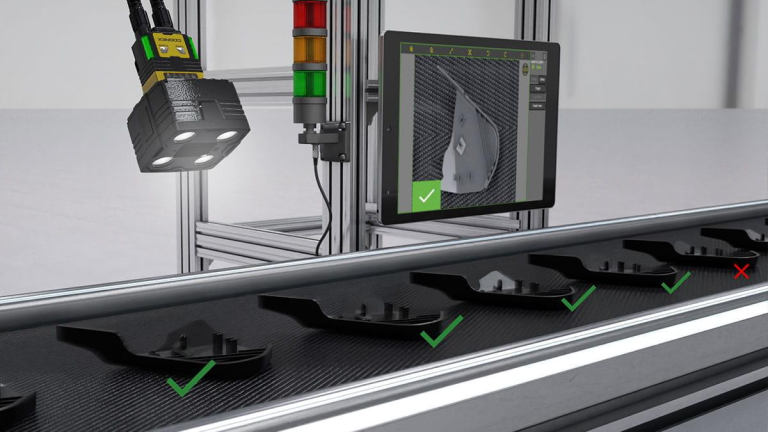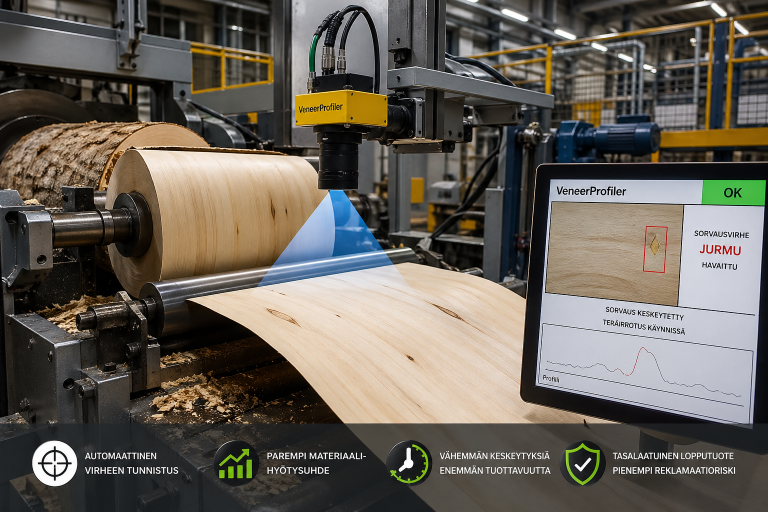
A single board processed in the wrong orientation can compromise the outcome of an entire production run. Santa Margarita’s SapWood board turning control, based on machine vision, ensures that each board is correctly oriented – automatically and in line with production requirements.
In the mechanical forest industry, including sawmills and downstream processing, automation and machine vision have significantly improved production efficiency, consistency, and competitiveness. Faster processes, reduced manual work, improved occupational safety, and minimized material waste have been key drivers of this development.
A recurring and critical requirement in wood processing is correct board orientation. Whether in planing, painting, pallet production, or the manufacture of glued laminated timber, boards must enter each process stage in the correct position. Santa Margarita’s solution for controlling board turning is built around this need. Its development dates back over ten years, originating from a request by the Vankkapuu pallet factory in Simpele.
From manual work to machine vision
In sawmills, visual and quality assessments were long performed manually, relying heavily on experience. While quality targets were clearly defined, the pace of production placed high demands on human decision-making. Assessing the quality or orientation of logs and boards requires constant attention. Materials move rapidly through production lines, and manually turning boards before planing can involve handling heavy pieces. The process operates as a continuous flow, where each step must perform reliably.
Machine vision and automation have introduced speed and repeatability to these stages. At the front end of sawmills, X-ray-based measurement and grading optimize log utilization, while board quality assessment is increasingly performed by machines. Visual grading remains a demanding but critical phase in the processing chain – and when performed by machine vision, it is more accurate and consistent than manual inspection.
The solution adapts to different production environments
Santa Margarita’s SapWood turning camera analyzes the board’s external shape and grain pattern. The system identifies the surface and heartwood orientation and transmits this information to the production line’s automation system. Its strength lies in combining multiple parallel methods, ensuring reliable results regardless of material variations.
The system works with a wide range of board types: small and large dimensions, end-sawn and unsawn boards, marked ends, and pieces with irregular edges. It integrates with various conveyor and turning systems, whether boards move side by side, in staggered positions, intermittently, or in continuous flow.
The speed of orientation detection meets even the most demanding production requirements. Results are displayed in real time, and the system stores images for traceability and performance verification. Additional features – such as feed error detection, dimensional measurement, and classification based on growth characteristics – can be integrated. Artificial intelligence is applied where it adds measurable value.
Users are united by strict quality requirements
The solution is used by wood processing companies across Finland and Europe, from large industrial operators such as Koskisen Oyj’s sawmill to smaller single-line facilities. Installations range from Tervola to Hamina, as well as in Sweden, Denmark, and Germany.
What these users share are strict quality requirements. Correct board orientation is a key factor in overall product quality, and in many cases the SapWood system replaces earlier solutions that no longer meet production demands.
Correct orientation determines quality and yield
For customers, the most important criterion is consistent accuracy regardless of material. Turning must take place seamlessly in line with the rest of the production process. When orientation is correct, the end product meets quality standards, production remains efficient, and material waste is minimized – preserving the overall value of the process.
A practical advantage is that the system does not require adjustments when switching products, allowing production to continue without interruption.
Reliable turning as part of process control
Board orientation is a critical factor in many processing stages. While manual turning is possible, it requires continuous attention from a dedicated operator. Simpler methods may rely on limited indicators such as curvature, but in demanding production environments this is often insufficient.
A machine vision-based solution provides clear added value, particularly in high-speed production with strict quality requirements. Correct orientation is an integral part of controlling the entire processing chain.
The core remains, the methods evolve
The core principle of the SapWood application remains unchanged: the system determines board orientation using machine vision and transmits the data to automation systems. Over time, interpretation methods have improved, accuracy has increased, and additional features have been developed based on customer needs.
One example is control based on the straight face of band-sawn boards, developed directly in response to practical production requirements.
Board turning will remain a fundamental part of wood processing, and the demand for ever greater accuracy continues. Machine vision is now an established technology in the industry, and AI-based methods are further expanding its capabilities. In the future, wood processing will increasingly rely on solutions where AI identifies product defects, process conditions, and disruptions based on visual data. These systems generate and utilize data from the production process, enabling new forms of data-driven decision-making.