Production anomalies do not appear only as alarms or production line stoppages. Variations in quality, changes in material behavior, or process disturbances may develop gradually and go unnoticed for a long time. The earlier these changes are detected, the easier it is to limit their impact and address their root causes.
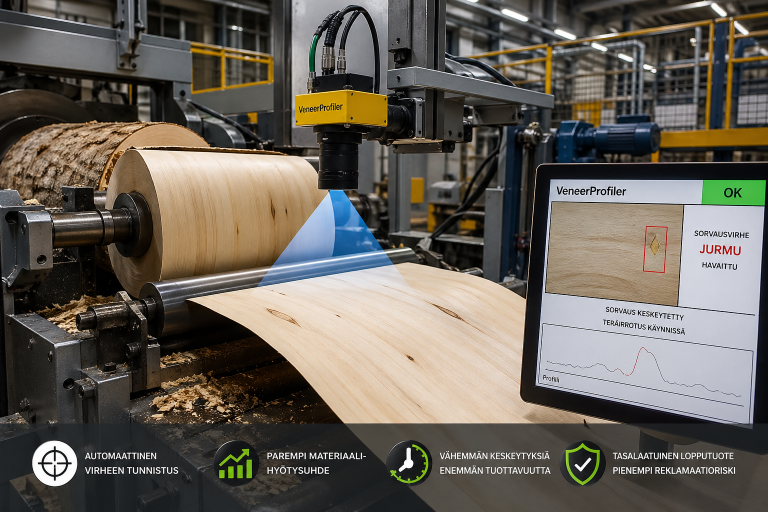
With machine vision, production events can be monitored continuously and consistently. Cameras generate observations from different stages of the process, so monitoring does not depend on individual inspections or occasional observations. At the same time, data accumulates that can be used to examine the occurrence and recurrence of anomalies, as well as their possible connection to other changes taking place in production.
A single observation rarely tells the whole story. The value lies in collecting enough observations over time to identify broader patterns. This makes it possible to examine whether certain anomalies occur, for example, under the same production conditions, with the same raw materials, or at specific stages of the process. In this way, connections can be identified that might otherwise easily go unnoticed.
Identifying the causes of disruptions becomes easier
A problem detected in production does not directly reveal at what stage of the process the anomaly originated. A quality defect discovered during final inspection may be the result of events that began much earlier. In such situations, identifying the root causes can be slow, especially if only limited information is available about what happened in the process before the anomaly emerged.
Machine vision brings a new perspective to the analysis by providing continuous information about events in the process. With the help of these observations, it is possible to go back and review situations in which changes began to occur and compare them with normal production. This helps narrow down the possible causes and target development measures to the right points in the process.
Machine vision also complements other data collected from production. Not everything can be measured with traditional sensors, but image-based monitoring can be used to track, for example, the movement, shape, surface, or behavior of materials. When visual data is combined with other production data, it creates a more comprehensive overall picture of how the process operates.
Implementation can begin with a single production challenge
Machine vision is often associated with large-scale automation and digitalisation solutions. In practice, however, implementation can begin with a very narrowly defined target. The starting point is a phenomenon observed in production whose causes need to be understood more precisely or about which more information is needed than is currently available.
At Santa Margarita, machine vision solutions are always designed on the basis of real production needs. The goal is to identify a phenomenon or challenge where the information generated can help improve operations and enhance process control.
The target may be, for example, quality variation, monitoring of material flow, or a recurring disturbance whose underlying factors are not yet sufficiently understood. A clearly defined objective helps in selecting an appropriate solution and also quickly provides information about what kind of benefits machine vision can deliver.
The solution can be implemented alongside the existing production environment without extensive changes to other systems. In addition to the camera itself, imaging conditions play a decisive role. Lighting, camera placement, and the characteristics of the object being imaged directly affect how reliably observations can be made.
Reliable operation requires the right conditions
In an industrial environment, operating conditions must also be considered as part of the overall solution. Dust, dirt, moisture, vibration, and other environmental factors can affect system performance, which is why protection and maintenance are an important part of the solution. Regular cleaning helps ensure that image quality remains high and observations remain reliable.
At the same time, a single use case can be used to assess where else in production similar information would be useful. This makes it possible to expand machine vision step by step to the areas where the information it provides best supports production monitoring, quality management, and decision-making.
At Santa Margarita, machine vision is approached through practical production challenges. The goal is not to implement technology for technology’s sake; we want to find solutions that generate useful information to support decision-making and process development. Solutions can be built in phases, allowing implementation to begin with a limited target and later be expanded as needed.