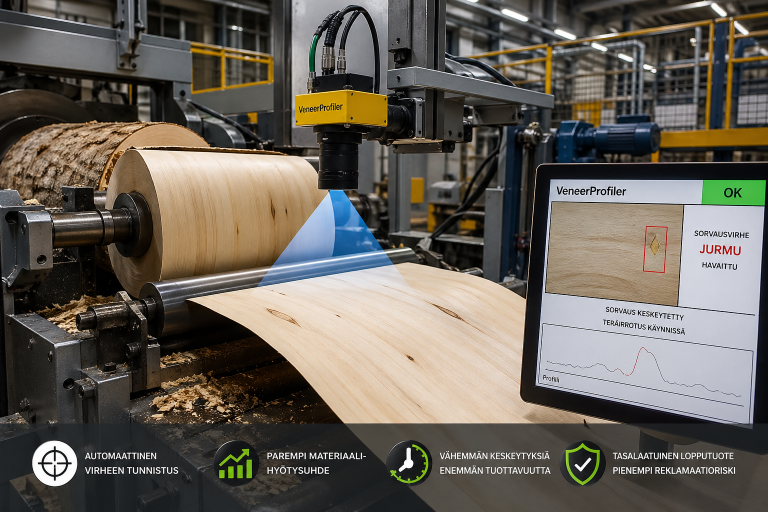
In plywood manufacturing, every veneer sheet forms part of a larger whole where quality is essential. One of the most critical process stages is the scarf joint, where the ends of veneer sheets are bevel-cut and joined together to create a continuous and sufficiently long veneer for further processing.
The quality of the scarf joint directly affects the strength and usability of the final product. Certain defects may lead to the rejection of the finished panel, while defects in inner veneer layers may only become visible later during surface finishing.
To ensure a high-quality end result, the ScarfMonitor system has been developed together with our customers. The system monitors the integrity of the scarf joint area and the adhesive application. In addition to supervising glue coverage on the bevel, it also verifies the structural integrity of the scarf area and confirms that the veneer sheet dimensions meet process requirements.
Veneer handling during scarf cutting is fast and dynamic. Veneer defects inevitably occur, and detecting them reliably through manual supervision is practically impossible.
What the system monitors
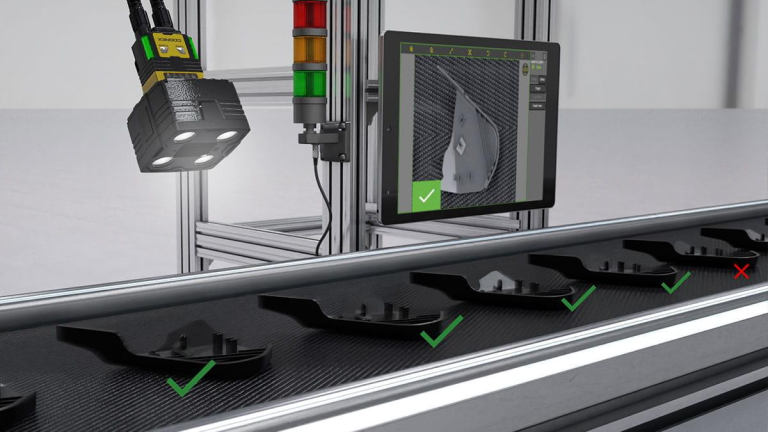
ScarfMonitor captures images of the veneer sheet bevels immediately after cutting and inspects the scarf area for:
- glue application
- gaps and cracks
- full veneer width
- hard-edge alignment and skewness
Defective veneer sheets are automatically rejected and removed from the production flow immediately after inspection.
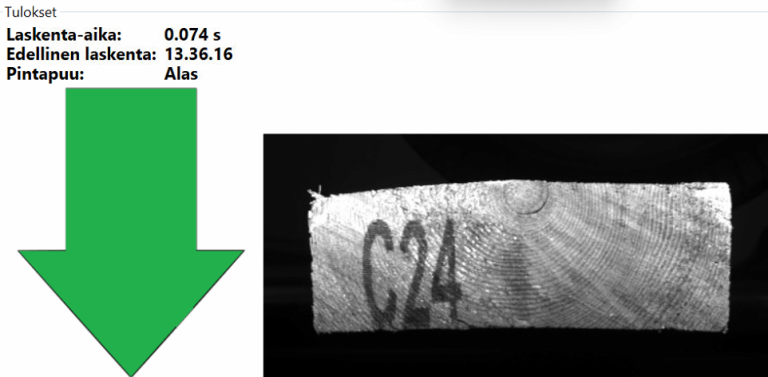
A significant advantage of the camera-based monitoring system is its ability to improve understanding of the production process. By reviewing scarf joint images either manually or in real time with AI-assisted analysis, it is possible to determine how many veneer sheets are rejected and identify the reasons behind scarf defects.
This information helps reveal the root causes of defects and supports process improvement.
Traditional photoelectric sensor–based monitoring does not detect all defects that affect product quality. For example, deep and narrow cracks can easily remain undetected and end up in the final product.
Less waste, better profitability
Automatic quality control delivers significant economic benefits throughout the production chain.
Traditionally, some defects may go unnoticed or are only detected at later stages of production, when the related costs have already increased. When scarf defects are detected immediately after cutting, both material waste and manual work are significantly reduced.
At the same time, the system collects production data and stores images of detected defects. Data analysis helps identify recurring defect patterns and their root causes.
For example, repeated glue defects may indicate a need to adjust the adhesive dosing equipment, while shape-related defects may reveal worn blades or mechanical deviations in the production line.
More than a single inspection system
Although the system can be described as a scarf monitoring solution, its functionality extends beyond bevel inspection alone.
It combines the inspection of geometry, adhesive application, and dimensional accuracy into one integrated quality control system.
This type of solution is especially valuable in high-speed production lines where manual inspection is not a realistic option.
ScarfMonitor forms part of a broader quality management and production optimisation process. Rejections can be targeted more accurately to actual defects, reducing unnecessary material loss.
At the same time, final product consistency improves and the risk of customer complaints decreases.
The result is a more efficient, proactive, and cost-effective production process.
Automatic scarf joint monitoring not only reduces production errors but also supports the continuous development of the mill, making it an essential part of modern plywood manufacturing.
For more information about the ScarfMonitor system
Santa Margarita Oy
Juhani Lehtola
+358 40 527 7592
juhani.lehtola@santamargarita.fi