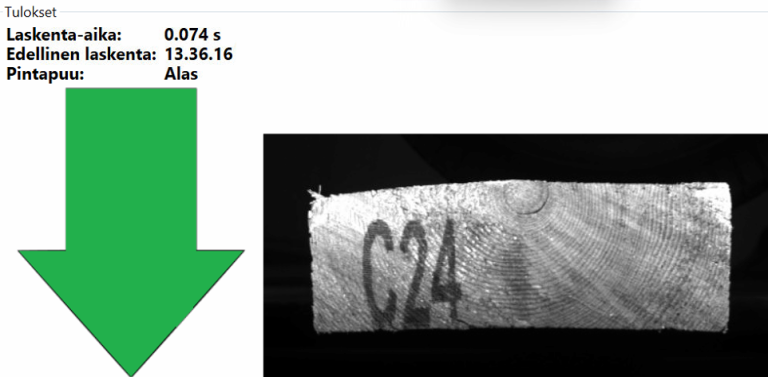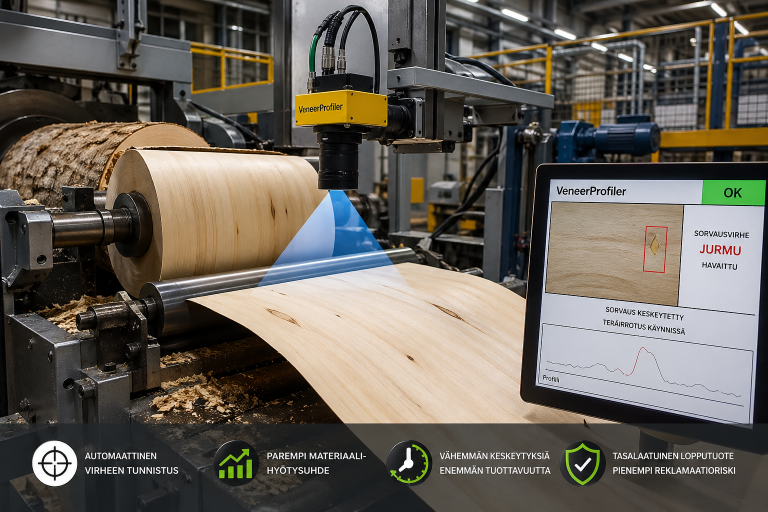
Production line errors and quality deviations can easily lead to additional work and unnecessary costs. With Santa Margarita, you can explore the possibilities of machine vision free of charge, starting with just a few photographs.
A lot happens on a production line before a finished product reaches the customer. Materials are moved, handled and processed, and various defects and quality deviations can occur along the way. Identifying them is not always straightforward, particularly when production speeds are high or large volumes of products need to be inspected.
Machine vision often provides a solution to challenges related to quality control and production processes. However, finding the right solution does not require a company to know in advance what kind of camera or system its production needs.
Santa Margarita helps industrial companies explore whether machine vision could benefit their production. The first step is surprisingly simple: just send us a few photographs of the problem.
Read on to discover how machine vision can help identify production issues and quality deviations.
The First Step Is Free of Charge
Companies considering an investment in machine vision do not need to start with equipment purchases or an extensive feasibility study. For an initial assessment, all we need are photographs of products or quality deviations that the company would like to identify automatically. A short video of the manufacturing process can also help us assess the possibilities for detecting production process disturbances.
Based on the images, Santa Margarita assesses whether machine vision could offer a way to solve the problem. This initial assessment is free of charge.
For example, paint surface defects can initially be examined using ordinary smartphone photographs. These provide a first indication of how the defects appear and whether further investigation into automated detection would be worthwhile.
An initial assessment does not yet establish how the solution would perform on an actual production line. However, it helps determine whether there is a good reason to investigate the possibilities further.
A Pilot Shows What Works in Practice
When the initial assessment indicates that further investigation is worthwhile, Santa Margarita prepares a preliminary cost estimate for the customer. This can then serve as the basis for a pilot project in which the solution is tested in practice.
For example, a camera can be brought into the production environment to investigate how the defects or deviations in question can best be captured. This provides practical information before the actual system is developed.
The scope and cost of a pilot depend on the specific case. A small-scale trial may require only a few working days, while a more extensive study will involve more work. Santa Margarita has also carried out free pilot projects, for example, for existing customers as part of other ongoing work.
The most important thing is to tailor the trial to the problem being solved. Every production line and inspection target is different, and there is no single implementation model that works for everyone.
Put Your Idea to the Test Before Investing
The idea of using machine vision can start with a very ordinary observation: a particular defect keeps recurring in production, quality inspections take too much time, or identifying a specific deviation is proving difficult.
Companies do not need to determine for themselves whether the task calls for traditional machine vision, AI or a combination of the two. What matters is identifying the problem and finding out whether it can be solved technically and makes economic sense.
One of the key benefits of a pilot is that decisions can be based on practical observations. It also helps determine whether the idea is worth developing further or whether an alternative approach would be more suitable.
→ Is there a defect or quality deviation in your production that you would like to identify automatically?
Take a few photographs and send them to us. We will provide a free initial assessment of whether machine vision could help. It could be the first step towards more effective quality control.