Artificial intelligence expands the capabilities of machine vision in situations where traditional methods alone are not sufficient. The key is to identify when AI delivers real added value – and what AI-enhanced machine vision can help solve.
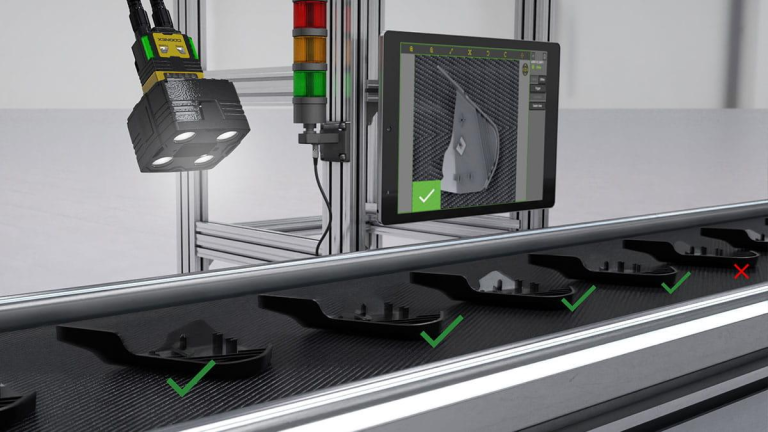
Traditional machine vision is at its strongest in applications where the target can be precisely defined. A system can, for example, measure the dimensions of an object, check the position of a component, or detect a predefined deviation. When it is clear what needs to be identified in an image and on what basis the observation is made, the task can often be solved computationally without AI.
However, not all objects being inspected are this straightforward. Products may exhibit natural variations in appearance, material surfaces and textures may differ, and defects can occur in many different forms. In such cases, defining all acceptable and defective variations in advance using predefined rules can become difficult.
This is where AI can bring added value to machine vision. Instead of defining every possible situation individually, the system can be trained using image data to recognise the characteristics and variations of the objects being inspected. AI can help, for example, classify objects or identify visual deviations that would be difficult to describe using unambiguous rules.
Not All Defects Need to Be Known in Advance
The potential of AI is also particularly evident in situations where not all possible defects are known in advance. A system can be trained to recognise what a normal, acceptable object looks like, allowing it to identify characteristics that deviate from this learned baseline.
This approach can be useful, for example, when inspecting surfaces and materials. It may not be necessary to define every possible defect type in advance. Instead, the inspection is based on identifying deviations from the learned normal state.
However, AI does not replace traditional machine vision methods. In many cases, the most effective solution is achieved by combining different approaches.
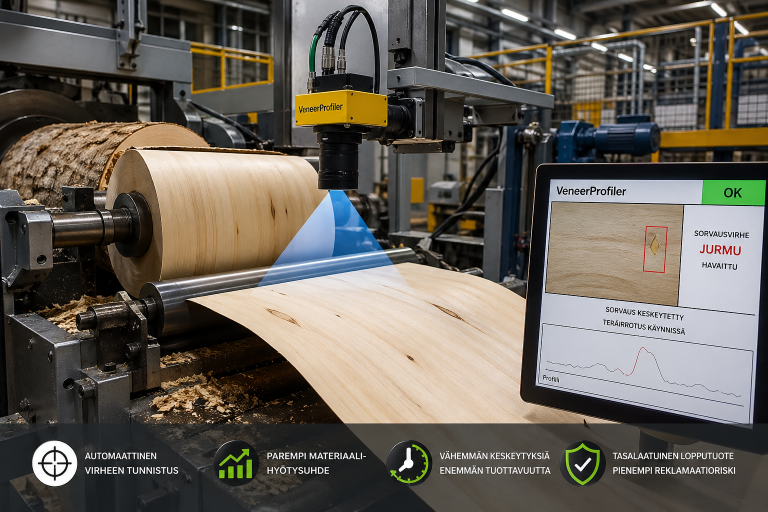
VeneerProfiler, developed by Santa Margarita for the plywood industry, is one example of this. The system monitors veneer quality and identifies defects by analysing the surface profile and other characteristics. The solution combines traditional measurement-based machine vision with AI. Both methods contribute to improving the overall result.
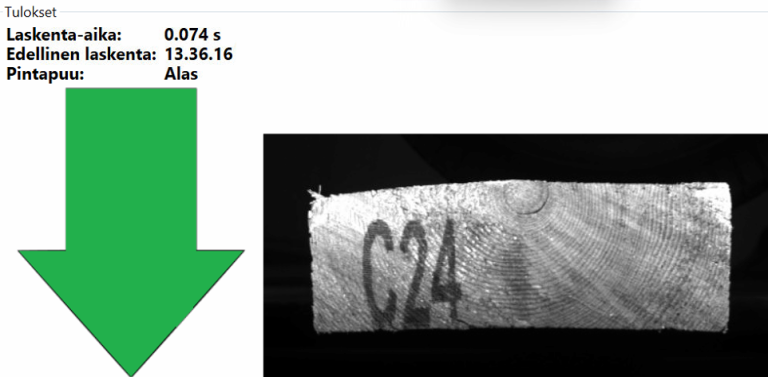
A similar approach is used in the SapWood board turning camera, which determines board orientation using several parallel methods. AI is applied in the parts of the process where it adds value to the overall solution. It is therefore not necessarily a choice between AI and traditional machine vision, but rather a question of which method is best suited to each task.
Applying AI Where It Adds Value
The purpose of AI-enhanced machine vision is not to replace existing methods with artificial intelligence. Instead, AI expands the machine vision toolbox, particularly when interpreting information obtained from images is too complex to achieve using clearly defined rules alone.
Using AI also introduces additional requirements. Suitable image data is needed to train the system, and the performance of the trained system must also be monitored after deployment. For this reason, the benefits of AI should be evaluated in relation to what the solution is intended to achieve and what its development and maintenance require.
The fundamental question is the same as in any machine vision application: what information needs to be obtained from the image, and how will that information be used?
If the task can be solved reliably using simpler methods, AI may not provide any additional value. However, if variations between objects, difficult-to-define characteristics, or unpredictable deviations make a rule-based solution too rigid or complex, AI can expand what machine vision is capable of achieving.
AI-enhanced machine vision is therefore not about using as much AI as possible. At its best, AI is applied precisely where it helps solve a production challenge more effectively.
→ Could AI bring added value to your company’s machine vision solutions?